
Of dogs and trout: The good, bad and hilarious of fishing with dogs | Michael Wright
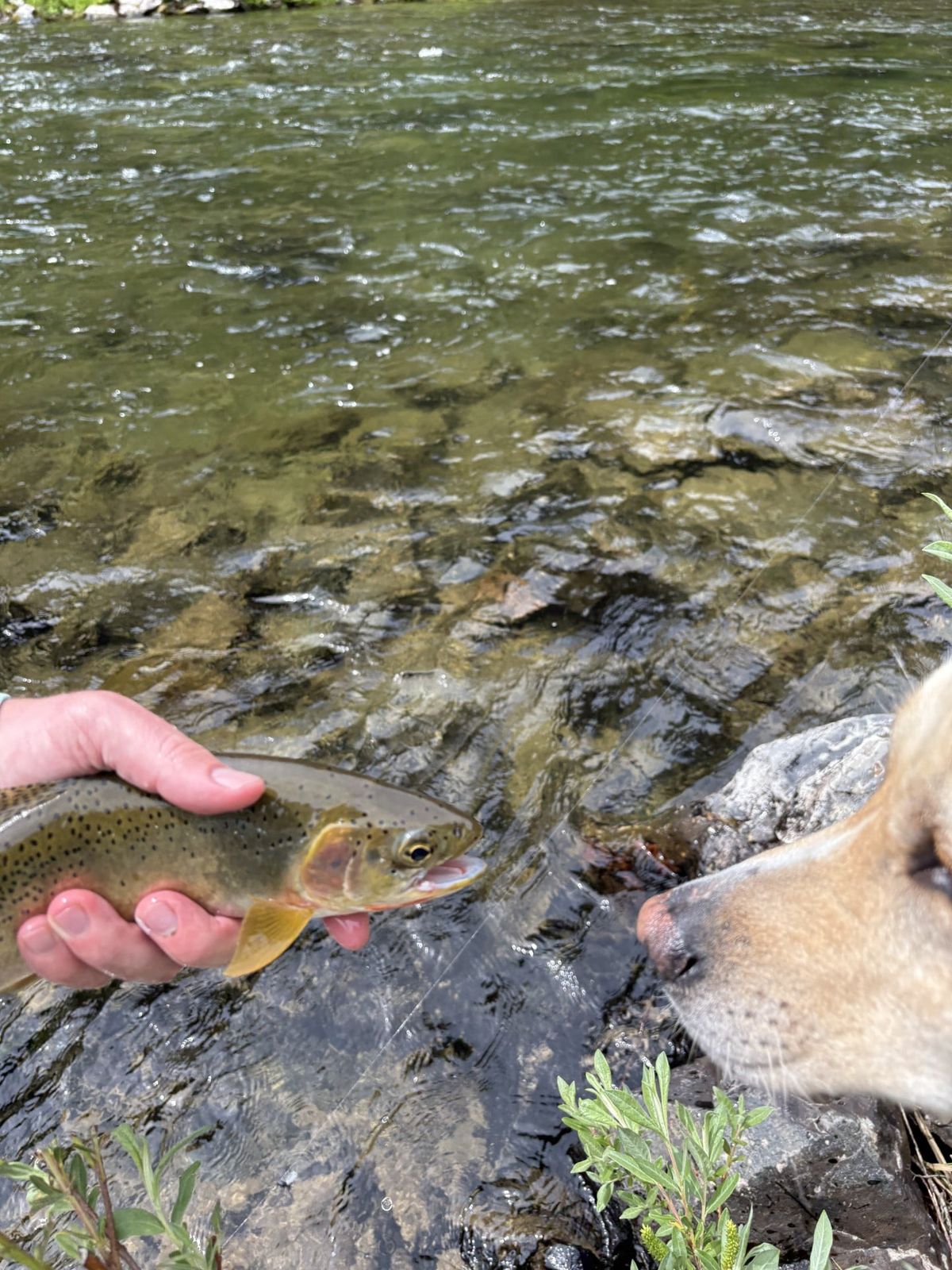
There were a few hiccups early in Wrigley’s fishing career.
He chewed up fly line, developed a taste for goose turds and generally made me wonder why I take him anywhere.
On his first trip up the North Fork of the Coeur d’Alene River, he bounded through tall grass and found plenty of reasons to ignore the humans yelling at him. He also found a deer carcass and went for a nice, long roll.
That gorgeous, undersized yellow Lab and I are on our third summer together now. He doesn’t come along on every fishing trip, but we’ve fished a lot since that first season. Some things have improved. He stays close and has decent manners with fish. He listens better, has (mostly) kicked his turd habit and he hasn’t made another attempt at eating fly line.
Other things have stayed the same. This May, at nearly the same spot on the North Fork, he rolled in another deer carcass.
I took him up the St. Joe River in early July. Fishing was slow all morning. Eventually, a few cutthroat trout started eating caddis. We fell into a nice rhythm. I reeled in the fish, popped the hook out and lifted it to his nose for a quick sniff and then sent it home.
His nose is in most of my fish photos from that day. The same is true of the photos from our May trip up the Coeur d’Alene. They’re convincing evidence of a fact that snuck up on me this summer, a realization I should have seen coming.
Wrigley has turned into a fishing dog.
He enjoys searching for grouse and pheasants in the fall, though I’m never sure he understands what we’re doing. He also likes the couch, and he’ll take any chance he gets to sneak into the neighbor’s yard.
But he seems right at home when standing at my hip on a river, waiting for a chance to sniff a trout.
Taking a dog fishing serves no practical purpose. They are observers, nothing more. People take them fishing because it’s just nice to hang out with them on a body of water. A dog is also a helpful reminder that fishing shouldn’t be taken all that seriously.
Still, there are people who believe that dogs and fishing don’t mix. They aren’t necessarily wrong. Some angling situations require leaving the dog at home. They don’t fit in float tubes, and they’re prohibited in some places. They rock boats, destroy gear and jump in the water without warning.
Wide -ranging dogs disappear for long stretches, which at best cuts into your fishing time and at worst results in serious damage. One friend stopped taking his English setter fishing after it ran into a yard along a famous Montana river and killed a chicken.
John Gierach, the late fly-fishing author, wrote in his book, “Trout Bum,” that people who fish with their dogs are “blinded by love,” and that there was “no such thing as a good fishing dog.”
A few years later, he amended that statement. In the book “Even Brook Trout Get the Blues,” Gierach wrote about a couple of well-behaved dogs he’d met since proclaiming that there were no good fishing dogs. He wrote that he had to admit that there are a few good fishing dogs, but that he still maintained “they’re few and far between.”
Dogs can be taught how to behave on a river. Rich Landers, the legendary former Spokesman-Review Outdoors editor and devoted bird dog man, uses an e-collar to teach his dogs – most recently, a Brittany named Ranger – to never wade in front of someone and to hold steady when a fish is caught. He also trains them to stay in a drift boat or raft until he says they can leave.
On the first trip of every season, he puts the dog through a quick training session to remind him of the rules. It cuts into his own fishing time, but Landers doesn’t mind.
“I see fishing as yet another fun-based opportunity to polish the training I’ve invested in my bird dog,” Landers said.
Wayne Jordan, the fly shop manager at House of Fly at North 40 Outfitters in Airway Heights, uses an e-collar on his 5-year-old Weimaraner, Valkyrie, but he hasn’t done much fishing-specific training.
“I just started taking her along with me when she was 9 months to a year old,” Jordan said.
It worked out well. Now, he takes Valkyrie fishing all the time. She doesn’t range out too far and is cautious about picking the right spot to cross a river.
Jordan’s biggest fear is Valkyrie running into a rattlesnake. There’s a solution for that – he leaves her at home when he ventures to central Washington during snake season.
Josh Mills has had three Labs and he said they’ve all been good fishing dogs. His training system is simple.
“Just taking them,” Mills said. “The only way through it is doing it.”
No dog is perfect. For example: When one of Mills’ Labs was 6 months old, it mistook a bobber for a ball and leapt out of the drift boat, taking an unplanned swim in Dry Falls Lake.
Mills’ current Lab, Annie, celebrates almost as wildly as he does when a fish gets hooked. She’ll lounge peacefully in a dedicated spot on the walleye boat or sit patiently on the banks of a steelhead river until she sees a bent rod. Then the tail starts wagging and she starts looking for her chance to sniff or lick whatever’s attached to the hook.
Annie is one of a bunch of wonderful dogs I’ve fished with over the past decade.
Wanda, a small black and white Pomeranian-German shepherd mix, is the perfect drift boat dog – small, silent and uninterested in tangling fly line. Hank, a treeing walker coonhound, enjoys sunning himself on a raft. The golden retriever brothers Milo and Rhubarb like swimming too much, but they’ll listen when told to get out of the way.
Some of my favorites are no longer around, which is just how it goes with dogs. There was Norman, a small black dog whose owner says he was “half border collie, half bullshit.” I followed him through an aspen grove along the Gallatin River once. He was a perfect gentleman.
Kaya, a mixed breed whose owner believes was mostly Gordon setter, was one of the best fishing dogs I’ve ever met. She roamed the banks quietly, always watching but always staying out of the way. Cancer sucks.
She lived with my friend Troy Carter and technically belonged to his wife, Beth. Now they have Wicket, who is half German shepherd, and Rooky, who is part English springer spaniel. Both are great fishing dogs.
Troy sent me a video recently from a trip to the Beaverhead River a few years back. It shows me reeling in a good brown trout with Rooky standing on the bank, supervising.
Under the video, Troy wrote: “Some dogs just love fishing.”