
Inside the WSU lab helping MLB verify its automated strike zone system
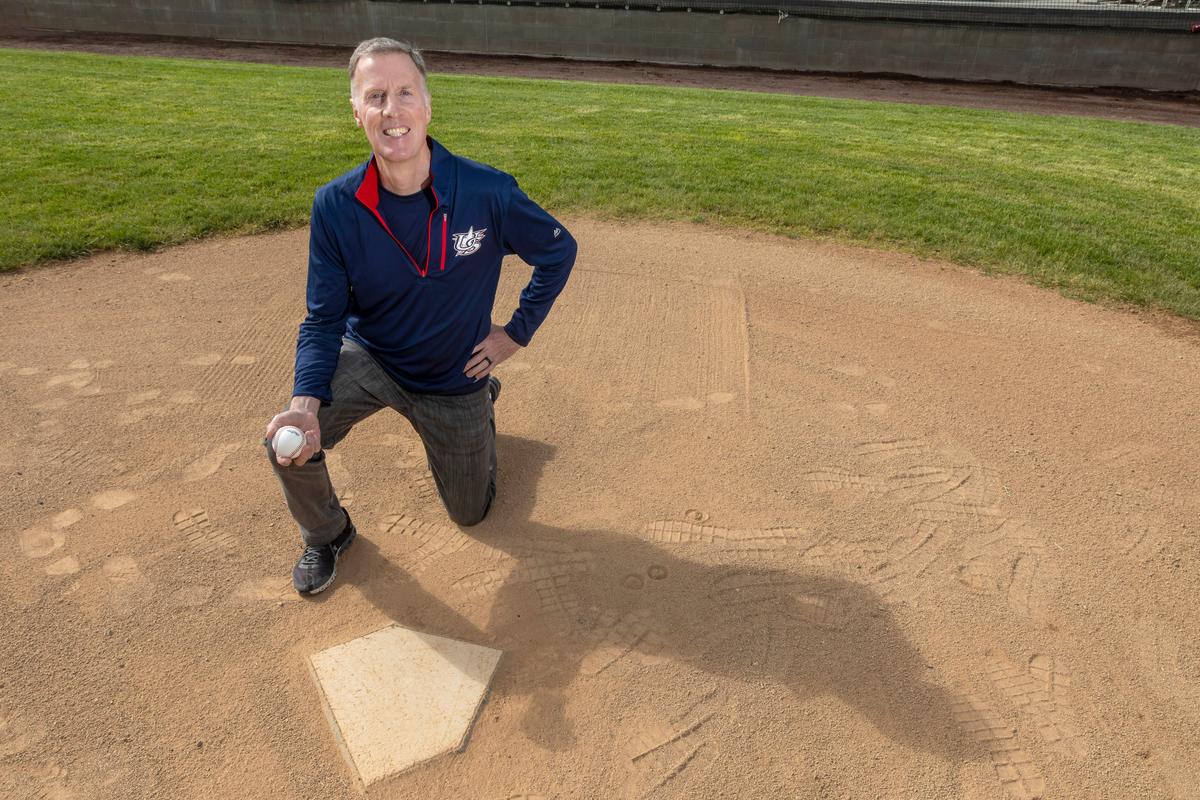
Long before major-league hitters tapped their helmets to challenge strike calls, a team of engineers in Pullman spent years verifying the technology that confirms or reverses a home -plate umpire’s decision.
Washington State University’s Sports Science Laboratory helps validate MLB’s Automatic Ball-Strike System, known as ABS. The technology uses high-speed cameras and tracking software to evaluate pitch location in real time.
For fans, ABS appears on a ballpark scoreboard in seconds after a hitter, catcher or pitcher initiates a challenge. For WSU’s lab technicians, it takes countless rounds of testing to make that possible.
“They are trying to have (ABS) systems that can be deployed very quickly, but yet still have the accuracy they need, so there’s lots of details,” lab director Lloyd Smith said about working with MLB.
The league sends WSU technicians to stadiums across the country, visiting major-league, minor-league and spring training venues. At each stop, the researchers set up custom pitching cannons and high-speed cameras that register 2,500 frames per second.
The trips generate terabytes of data, which researchers then compare against MLB’s pitch-tracking systems before delivering reports back to the league.
Setup alone can take roughly 90 minutes.
“That’s the hard part because everything just needs to be really well done,” Kyle Wait, the lab’s Ground Truth Specialist said. “The way our calibration works, we have two cameras, and then we use stereo vision to create the depth of field and get all those measurements. But those cameras can’t move, and if they do move, we need to recalibrate.”
Wait is part of a two-person crew that handles most of these trips. He’s joined by technologist Tyler Danby, and both researchers have worked in the lab for at least six years.
When they arrive at ballparks, there is rarely a formal welcome or any margin for error. With stadiums hosting near-daily events for much of the year, they are under pressure to get set up, run tests and leave as quickly as possible.
“We can get in and out in four hours, which is a huge deal for the parks,” Danby said. “When we’re on the field, we’re walking on their grass, and they’ve got events going on or games the next day.”
Even the playing surface itself presents challenges.
“When you’re up in the stands and you’re looking out at the field, the field looks flat,” Wait said. “But you don’t realize there’s imperfections. The plate is wavy, it’s tilted, it’s sunk in, it’s above the ground.”
Another hurdle is airport security. Wait and Danby are often stopped by TSA agents over baseball-filled suitcases and pressure-vessel equipment that occasionally resembles suspicious devices.
“They really don’t like when I travel with the baseballs because they look really strange,” Danby said. “I’ve had one swabbed and it came back for nitrates – an oxidizer used in explosives, so they don’t like that.”
As MLB embraces technology like ABS – with WSU helping validate the systems behind it – the research has also raised questions about the future of umpire-enforced strike zones.
According to Smith, modern pitch-tracking systems can determine whether a pitch will be a ball or strike before it even reaches home plate.
“The audience delay is entertainment,” Smith said. “If it were me, as an engineer, there would be a red or green light instantly. But it’s just fun for the audience.”
WSU’s relationship with MLB extends beyond ABS. Researchers have also been involved in studying the league’s home run surge, which began around 2015 when home run rates spiked.
“And then in 2016, it continued, and Major League Baseball said, ‘that still could be a statistical anomaly,’ ” Smith said. “Then in 2017, it continued, so they said, ‘OK, forget it.’ ”
The league assembled a panel of physicists, engineers and statisticians to investigate the spike. Researchers at WSU quickly identified one likely culprit: changes in the baseball’s drag.
The challenge was figuring out how to measure it consistently.
Baseballs are still hand-stitched, meaning subtle differences in seam height can significantly alter how the ball travels through the air. According to Smith, even changes of less than 5% in seam height could significantly affect home run rates.
That work eventually led WSU engineers to develop systems that measure seam height and aerodynamic performance. They tested baseballs using a cannon to launch them with realistic spin, along with light sensor gates to track ball position and speed.
Much of the lab’s day-to-day work, however, revolves around bat testing.
Smith’s team primarily tests hollow bats sent by companies like Rawlings, Easton, DeMarini, Wilson, Marucci and Worth. Many arrive as unmarked prototypes before public release.
Researchers fire 140 mph knuckleballs at stationary bats to simulate the collision between a 70 mph pitch and a 70 mph swing – the NCAA’s model for testing bats.
“Performance began to be a problem in the ’80s and ’90s, and that’s when I got involved,” Smith said. “They said, ‘OK, great, the game is now too fun. You can hit the ball too far. Games are getting long, everybody’s getting home runs. We’ve got to control this.’ ”
Smith said the challenge is balancing performance with safety and fairness.
“What we’ve done is come up with the simplest way to correctly measure bat performance, and by making it simple, it makes the test repeatable,” Smith said. “So this is the version of our test where we’re measuring bat durability.”
While baseball-related testing “makes the money,” according to Smith, the laboratory has graduate students looking into boxing gloves, the performance and durability of Taekwondo headgear and the high-speed impact of a softball. Past students have also studied heading in soccer, shuttlecock drag in badminton and ice hockey sticks.
Another focus of researchers is the fast-growing sport pickleball, particularly addressing questions about the performance of pickleball paddles and balls. It was funded by a grant from Selkirk Sports in Coeur d’Alene – the largest manufacturer of pickleball paddles.
The lab’s growing footprint in sports technology came into focus when WSU hosted the biennial International Sports Engineering Conference. The four-day event wrapped up on June 4, bringing researchers and industry leaders from around the world to Pullman.
For Smith, the broader direction of sports science is moving beyond measurement and into decision-making and strategy, figuring out “how to play the game better.”
Those questions are increasingly shaping how teams think about performance across sports.
“The fun thing about sport is that it’s something we all understand,” Smith said. “Many of the games are hundreds of years old, and we just keep doing the same thing because we’ve enjoyed it. But when you sit down and look at it from a scientific standpoint, you realize we really don’t know much about the science behind this.”