Behind Mariners’ hitting philosophy and ongoing search for answers on offense
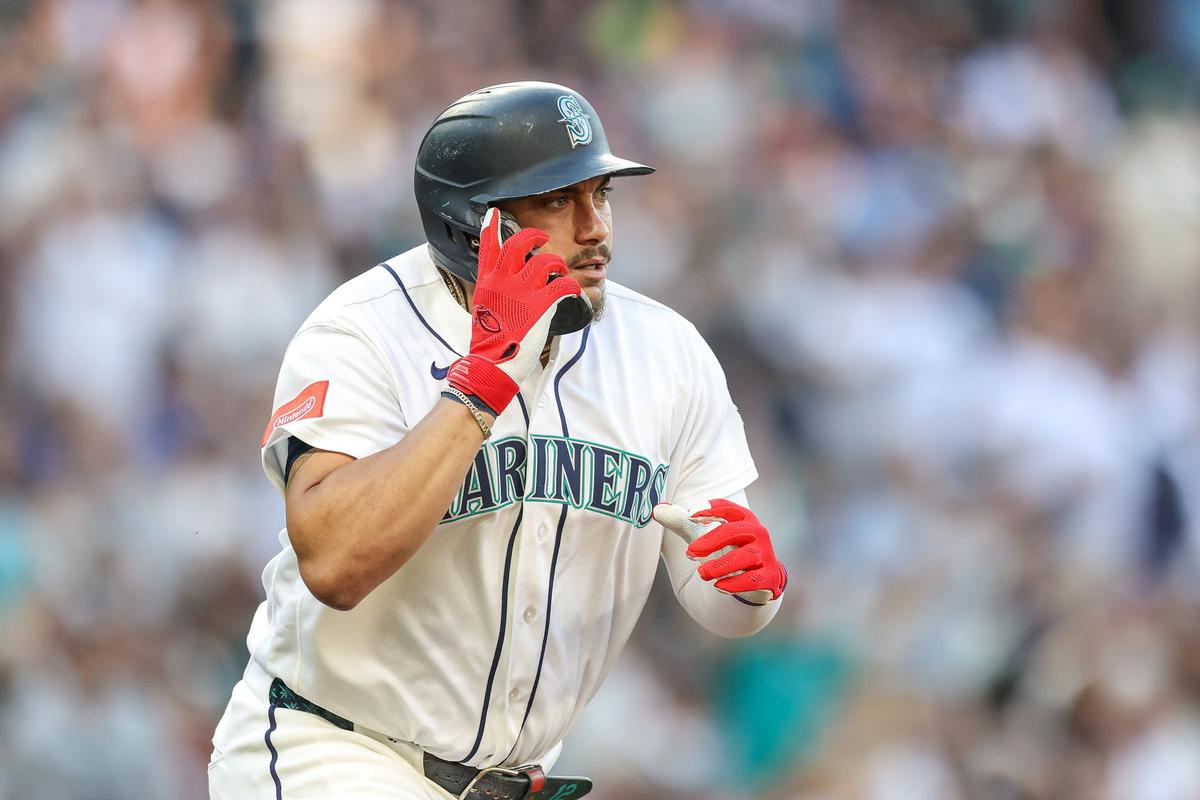
HOUSTON – In their ongoing search for an offensive identity, the Mariners have circled back to the beginning, to the most basic principles of Hitting 101.
“We’re just trying to simplify everything,” hitting coach Kevin Seitzer said, “and get them on the fastball and get something that they can hammer and be on time.”
Perhaps Mariners hitters unlocked something this weekend in Houston, where they combined to score 20 runs and racked up 35 hits, taking two of three from their AL West-leading rivals and keeping alive a glimmer of hope for the season’s final six weeks.
With 37 games remaining, the Mariners (59-66) are four games back of the Astros for the top spot in a division as dreadful as any the sport has seen in recent memory.
The next three series against playoff teams – starting Tuesday in Milwaukee, followed by a home stand against the Cubs and Phillies – will be telling for the Mariners. If they can stay within arm’s reach of the Astros for the next two weeks, they could reasonably expect to make another late-season surge with a September schedule that, on paper, has to be the easiest in franchise history.
The offensive numbers up to this point, though, have been woeful. The Mariners sit at or near the bottom of the majors in virtually every statistical category. Production only deteriorated further in the two weeks after the dismissal of popular assistant hitting coach Bobby Magallanes in late July.
The steady drumbeat of disappointing at-bats has worn on players and coaches.
“It’s been probably the most frustrating year of my career as a coach,” Seitzer said Friday afternoon, sitting inside the visitors’ dugout in Houston. “Just because (of) how hard these guys are working and how much they care and the way they’re competing, their attitudes. It’s everything you can ask for.”
For Mariners hitters, playing half their home games inside T-Mobile Park is always going to be a challenge. It’s where “right-handed hitters go to die,” as one veteran scout said recently.
Solving the Rubik’s cube that is hitting in Seattle has proven to be an excruciating endeavor for the Mariners as an organization.
“If there was a magic pill, we would have had them all take it by now,” Seitzer said, speaking broadly about the hitting group.
• • •
The Mariners have tried just about everything the past few years to establish a consistent offensive identity.
In 2024, hitting coaches Brant Brown and Jarret DeHart were heavily invested in a modern, data-driven approach. Hitting home runs was, above all, the priority; coaches often asked hitters to try pull the ball off the foul pole to do so.
The hitting philosophy went to the other extreme when Seitzer and Magallanes took over at the start of 2025, with franchise icon Edgar Martinez also involved as a hitting strategist.
Hitters, at the time, hailed that traditional approach – try to hit line drives up the middle – as simple and refreshing. And it worked last year, when the Mariners ranked as one of MLB’s best lineups and finished second in the AL with 238 home runs, buoyed by Cal Raleigh’s historic 60-homer breakout.
Over the past two seasons, no team has relied more on homers more than the Mariners; roughly half of their runs have come via the home run.
It was no surprise, then, when the Mariners’ run production really began to cool off in June. Their home-run totals took a dramatic downturn from 42 in May, tied with the White Sox for MLB’s most, to 29 in June, among the lowest in MLB. The correlation was clear.
“All I know is we tend to win games when we hit homers. And to hit homers, you need to pull the ball,” one Mariners hitter, who was granted anonymity to speak candidly, said last month.
“It’s fair,” he added, “to say we are a group at a crossroads.”
Roughly two-thirds of all MLB home runs are hit to the pull side, and on the surface, the Mariners’ reliance on pull-side home runs would seem to be at odds with the team’s overall up-the-middle approach.
Seitzer and M’s manager Dan Wilson pushed back at that suggestion.
“I don’t think the two are mutually exclusive,” Wilson said. “Having a good (up-the-middle) approach does allow you to hit the ball out of the ballpark … and that’s what we’re looking for.”
One of the pitfalls Seitzer wants hitters to avoid is stepping up to the plate trying to hit a home run.
“Home runs are a byproduct of a good swing and being on time,” Seitzer said. “Whether that’s a fastball or an off-speed pitch, if you put a good swing and you’re on time, it’s got a chance to go out of the ballpark. But when you’re up there trying to hit homers or go pull side, that’s when you chase more often. You get fooled more often.”
It was encouraging for Wilson that, of the Mariners’ 17 runs against the Astros on Friday and Saturday, the first 14 were scored without the benefit of a home run.
Maybe they have turned a corner. Maybe they have begun to morph into the type of dynamic offensive they envisioned being at the start of the year.
“Sometimes you can forget how important a single is,” second baseman Cole Young said. “Just putting pressure on the defense and like – whether it’s a walk or a single – just getting on base. And I think it shows how important it is.”
Wilson is hopeful that can be contagious up and down the lineup.
“It’s more of a gritty mentality; it’s more of a fighter’s mentality: ‘I’m going up there and I’m looking for hits,’ ” Wilson said. “Sometimes when we’re looking for homers, that’s just a harder goal.”
• • •
Injuries, to be fair, have been a major factor in the Mariners’ offensive issues.
Just 16 times this season have the Mariners had their preferred starting lineup, with Brendan Donovan batting leadoff and Randy Arozarena, Julio Rodríguez and Cal Raleigh all healthy at the same time.
Raleigh’s dramatic about-face remains the biggest storyline around this team, but it has been suggested that he will need a full offseason to completely heal from an oblique strain that derailed his start to the season.
“He tried to play through the oblique thing for a long time at the beginning of the season and couldn’t get his swing off,” Seitzer said. “He was scuffling and then took a month off, and then coming back (he’s) trying to play catchup and it’s, like, he’s just not synced up. He doesn’t feel right with his swing, and when you’re fighting your swing, the game speeds up on you.”
A year ago, Raleigh’s chase rate – swings in which he chased pitches out of the zone – sat at 31.8%. This year, it has spiked to 36.2%, a career high over a full season. (Julio Rodríguez, at 41.3%, and Josh Naylor, at 39.1%, also have two of MLB’s highest chase rates this season).
Lately, Raleigh has been especially susceptible to high fastballs above the zone, and it’s clear opponents are game-planning specifically for that. They won’t stop until he stops swinging at them.
“He’s well aware of that. We’ve had those conversations and we’ve pulled the numbers up,” Seitzer said.
Beyond Raleigh, Seitzer said he’s had many conversations with hitters over the past month urging them to play with more freedom.
“Our pitching’s been dynamic and we can’t get enough runs for them. It’s unacceptable,” Seitzer said. “It’s been a grind most of the year. The thing from a coaching standpoint is, you want to be like this (holds his hand steady and flat) with these guys all the time, so they have no idea of what I feel in my gut every day. But I’m going to bring positivity and energy and make sure they’re prepared, make sure that they’re in the best frame of mind they can be going into every night, and they are.
“It’s something that’s got to turn. It’s something that’s got to change. We’ve got to get hot like we got hot last year. We were in a similar place last year, and the guys turned it around. So I’m hopeful. Every day I show up I’m expecting, OK, this is the day that something’s going to click.”