
A woman died while evacuating the Old Trails fire, the first known death tied to the blaze
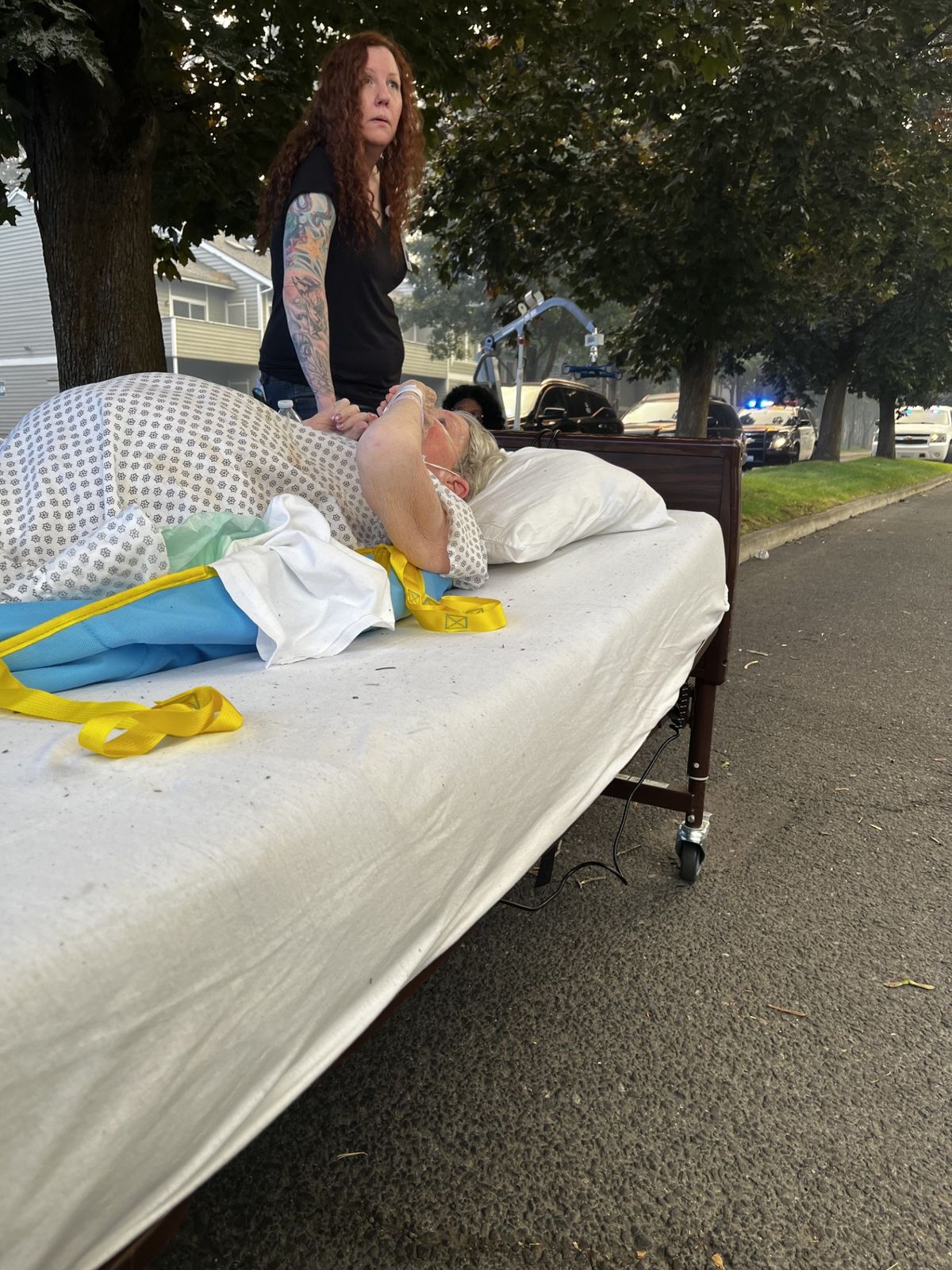
A 73-year-old woman is dead from medical complications she suffered while evacuating a nursing home during the start of the Old Trails fire, her daughter said.
In the scramble to evacuate Spokane Health and Rehabilitation on Aug. 1, resident and hospice patient Pat Speedy’s bowels ruptured, her daughter Kimberly Speedy said, likely from being wheeled in her hospital bed along the uneven terrain of the parking lot. She died on Aug. 9.
The 73-year-old was hospitalized upon evacuation, where she spent days “in agony” before ultimately dying of a colonic bowel perforation, according to the funeral home preparing her remains and death certificate. She was in hospice care at the nursing home for about six months, her daughter said, but was otherwise “stable”: comfortable, not in pain and her usual talkative, funny self.
“The way she went, that’s hard to wrap my heart around,” Kimberly Speedy told The Spokesman-Review. “I wanted more for her. Better for her.”
Pat Speedy’s death is so far the only fatality reported to authorities that is connected to the wildfires, Sheriff John Nowels said. His office will investigate the circumstances and facts of her death as it relates to the ongoing case against arson suspect Aaron Farinacci, who investigators allege confessed to intentionally starting the Old Trails fire on the West Plains that spread into Spokane and consumed 615 structures and over 3,100 acres. Without knowing more, Nowels said he couldn’t say whether Farinacci could face criminal charges associated with Pat Speedy’s death.
“There is potential, depending on the evidence and the circumstances, that we could add additional charges to the person who started the fire,” he said after learning some of Pat Speedy’s story.
Pat Speedy lived at the nursing home for four years after she was bed-bound from a stroke, her daughter said. While there, she was diagnosed with Ogilvie syndrome, her daughter said, a condition in which the colon is paralyzed and doesn’t move food through the intestines, causing a person’s colon to expand as food builds up. Pat Speedy moved into hospice care at the nursing home off Assembly Road two months after the diagnosis, which can be fatal, her daughter said.
According to Kimberly Speedy, her mother loved living at Spokane Health and Rehabilitation. She made friends with other residents, got to know her caretakers and, despite being bed-bound, “was actively engaged in life.”
“She was still very lively and had a great sense of humor and loved to visit with everybody; it’s just a tragedy that this is how she went out,” Kimberly Speedy said. “That wouldn’t have happened had the arson fires not been set; she’d still be in the room visiting with her friends.”
Before the fires, Pat Speedy was eating regularly and didn’t complain of pain. That changed abruptly while in the nursing home’s parking lot as she waited for evacuation, her daughter said.
“She could tell immediately; she said, ‘Something’s really wrong,’ ” Kimberly Speedy said of her mother.
As the wind began to pick up in Spokane on Aug. 1, Kimberly Speedy left town to visit her father in Clarkston. It was the same routine she’s done for the past 21/2 years, splitting her week between her aging parents, caring for them separately.
She had a gut feeling something wasn’t right as she left town. A friend confirmed her uneasiness, calling to let her know she should check on her mother because a fast-moving wildfire was closing in on the Indian Trail neighborhood, where the nursing home is located.
When she arrived at the facility along Assembly Road, it was a dire scene, Kimberly Speedy said. She could see smoke swirling in the air while a dozen caretakers and 115 residents in hospital beds and wheelchairs waited for “rescue” from Spokane Transit Authority buses assigned as evacuation shuttles.
For about an hour of coordinating the evacuation, “ash was dropping on their beds and in their laps,” Kimberly Speedy described of the largely nonambulatory residents.
“Ash was just coming down. The sky was dark,” she recalled. “Imagine being not in control of your body and having to watch everything around you burn.”
Her mother was among the last to be evacuated. Buses were full, so a nearby resident who came to aid in evacuations wheeled her in her hospital bed across the uneven parking lot to Assembly Street, where an ambulance transported her first to Shadle Park High School, then to Holy Family Hospital.
An X-ray revealed the ruptured bowels. Doctors told Kimberly Speedy it likely burst in the bumpy ride in her hospital bed.
She was alert for three days in the hospital. By the fourth day, Pat Speedy was slipping in and out of consciousness and was in severe pain. She was transferred to Reidt Care assisted -living facility and died there on Aug. 9. Kimberly Speedy was at her mother’s side in her final moments.
“The last thing she said was, ‘It’s OK, honey, I don’t need any jellybeans.’ ”
It was a quintessential Pat Speedy sentiment.
“She just had a great infectious personality, a great sense of humor. That’s one of the things that people associate her with is a great sense of humor,” Kimberly Speedy said. “She loved Gonzaga basketball. She’s from California, so very much a Cali girl; she loves the beach and the sun and palm trees.”
In the days since her mother’s death, Kimberly has been in Clarkston with her father, who she said is showing early signs of dementia. They both struggle to comprehend Pat Speedy’s death. Kimberly said it was avoidable and plants the blame squarely on 37-year-old arson suspect Farinacci.
“It’s unbelievable this guy has such a disregard for human life,” Kimberly Speedy said. “I don’t know, that needs to be taken into account. There’s a lot more damage than just structural.
“I want him held accountable. This guy killed my mom.”
The public defender representing Farinacci, Colin Charbonneau, did not respond to multiple requests for comment Friday afternoon as he was out of the office.
Spokane County Prosecutor Preston McCollam also could not be reached Friday.
Sheriff Nowels was unaware of the specifics of Pat Speedy’s death when reached Friday on his way to a family vacation. He said his office would investigate her death as it relates to the case against Farinacci, but couldn’t say if there’s enough evidence to suggest charging Farinacci with Pat Speedy’s death.
That would depend on whether there’s a strong enough case that her death was the direct result of evacuation from the fire, he said. Her medical history, the fact she was in hospice care already and the culpability of other people involved in her evacuation are all factors his office will investigate, he said.
“There’s going to have to be a lot of work that goes into it, but those questions are answerable,” he said.
These are similar questions authorities sought answers to in another wildfire set states away over a decade ago.
In 2015, a 25-year-old man pleaded guilty to recklessly starting the Boles fire, which consumed over 500 acres and 150 structures the year before in the small Northern California town of Weed.
During evacuations for that fire, a woman fell and later died in the hospital, according to reporting at the time by the Record Searchlight newspaper of nearby Redding, California.
Prosecutors considered seeking a murder charge in the case, on top of three felony counts of arson, but there wasn’t enough evidence to suggest her death was a “direct fleeing-from-the-fire situation,” said Kirk Andrus, Siskiyou County district attorney, according to the newspaper.