
Interior Secretary Sally Jewell: Wildfires need separate disaster funding

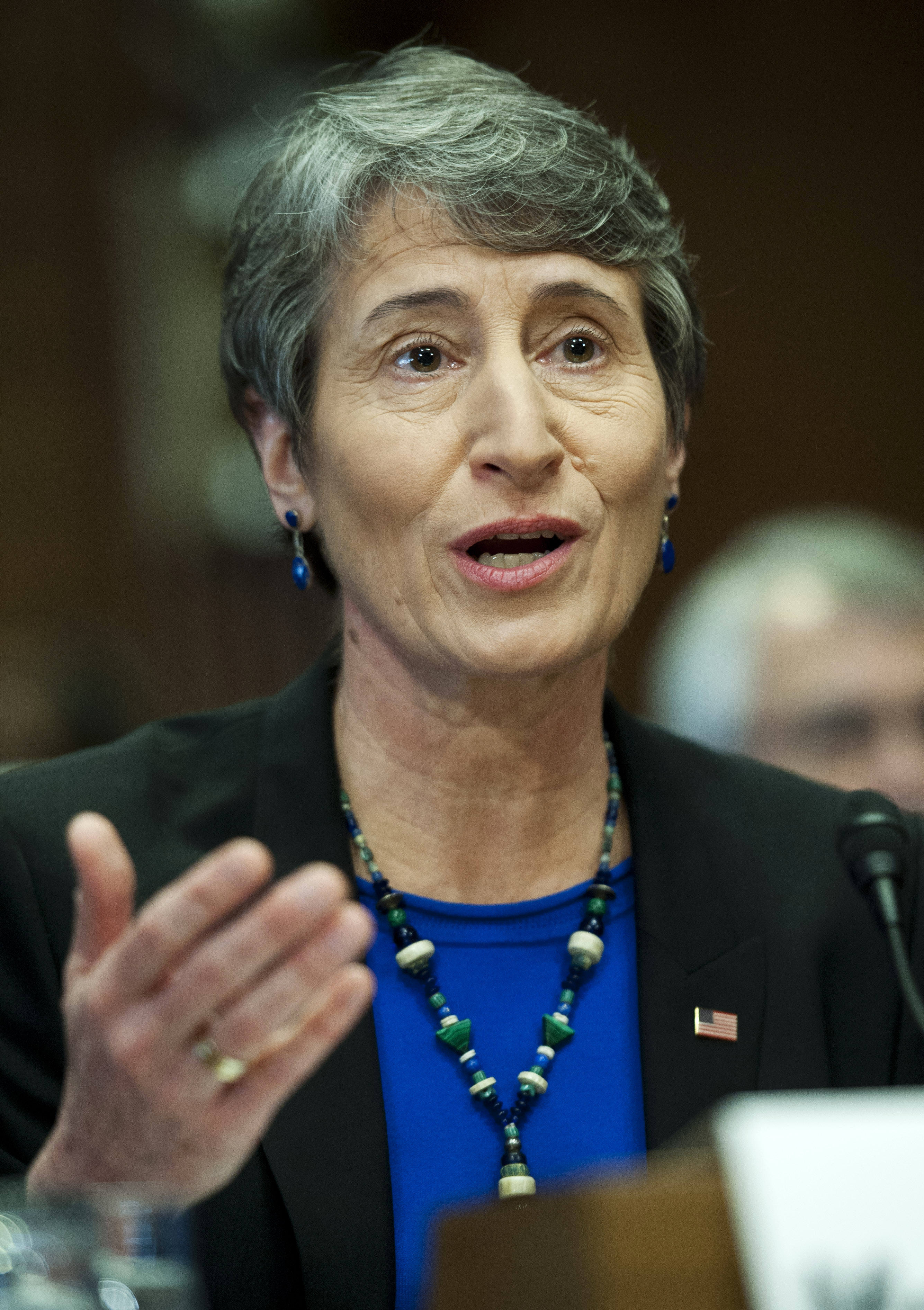
OMAK, Wash. – Wildfires need to be funded as the disasters they are, leaving critical fire prevention budgets in place for thinning dense forest stands, rehabilitating areas after wildfires and making sure communities are more resilient to fire.
That was the main message from U.S. Secretary of the Interior Sally Jewell, who visited the North Star and Tunk Block fire camp in Omak on Monday for a briefing from fire commanders.
Jewell said the 9 million acres that have burned across the country so far this year make this summer among the six-worst fire seasons on record, dating to when accurate record keeping began in the 1960s.
The North Star and Tunk Block fires near Omak have together burned more than 370,000 acres – most of it on the Colville Indian Reservation – and forced thousands of people to evacuate for weeks as their homes continued to be threatened.
Jewell called for a new kind of response by the federal government, to treat the largest fires as disasters.
“Fires of this magnitude is not normal on the landscape,” she said. And while firefighting is perhaps the best example of where state, tribal and federal governments experience excellent cooperation, she said, “We do not have the capacity to treat it as the disaster it truly is.”
FEMA’s Region 10 administrator Ken Murphy welcomed the proposal. “Fires are disasters,” he said. And while his agency has provided 11 fire management assistance grants in Washington state this summer, “I really hope Congress and this administration can figure out a way we can actually treat them as disasters.”
Jewell said President Barack Obama has called for a new framework that would allow agencies like the Federal Emergency Management Agency to respond as it does in hurricanes or tornadoes. The fix would provide more certainty in funds for the growing fire suppression needs, and preserve money for prevention and rehabilitation.
But it’s been a difficult sell in states where wildfires are not prevalent. “People in the east don’t get it,” she said. “We need to make sure our voices are heard.”
Both the North Star and Tunk Block fires were ignited by lightning on Aug. 14, when resources were already stretched thin across the country.
Jewell said nationwide, the country was not yet at a Preparedness Level 5, when 80 percent of all Type 1 and Type 2 teams are committed, bringing the potential to exhaust all agency firefighting resources. But there were not enough resources to fight all the fires that were started, and only 50 people were involved in the initial attack of the now 209,999-acre North Star fire.
Jewell said Alaska firefighters are often finishing their season at that time, and ready to be deployed to other states. But this year, Alaska remained hot and fires continued to burn there.
Washington Public Lands Commissioner Peter Goldmark added that hundreds of orders for resources went unfilled until recently.
“Frankly, we were tapped out here in the Western U.S.,” he said.