
Promising new act
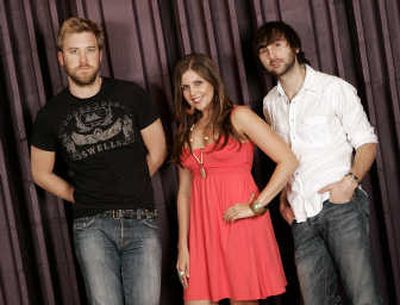

Lady Antebellum’s Dave Haywood remembers the day he co-wrote one of the best songs of his young career – and then got punched in the face.
The group’s guitarist was at a pizza place that night and walked to his car to retrieve a recording of the tune to play for some friends. He had the CD in his hand when four guys jumped him and tried to take his car keys.
They roughed him up, but he escaped with his keys and his CD, and today “Things People Say” is one of the group’s favorites cuts on its self-titled debut album.
“If they’d only known that that’s what they needed to take,” singer Hillary Scott joked with Haywood during a recent interview at a Nashville studio.
In short order, Lady Antebellum has become one of country music’s most promising new acts with a sound that has far more in common with ‘70s and ‘80s pop than traditional country.
Their debut album hit No. 1 on the country chart, their lead single, “Love Don’t Live Here,” is No. 5, and last month they won the Academy of Country Music’s award for top new vocal group.
“In my wildest dreams I never imagined it would happen like this,” said Charles Kelley, the trio’s other principal vocalist with Scott.
When they first got together a couple years ago, it was with the idea of writing songs. Scott and Kelley already had fledgling solo careers. No one suggested forming a band until later, after they’d done a few club shows together.
“We had so much fun,” Scott recalls. “I never felt that comfortable on stage. Before I was performing as a solo artist and Charles was performing with Dave as a solo artist.”
However, he says, “When the three of us got on stage together, we could interact together and there wasn’t as much pressure just on you.”
Word spread, and Capitol Nashville signed them last year.
Their songs, most of which they worked together to write, are an amalgamation of country, pop, rock and R&B with tight harmonies and alternating male/female lead vocals.
The pop-leaning first single showcases their sound as well as anything on the record, with Kelley’s husky vocals providing a bluesy rock edge.
The disc was co-produced by Paul Worley, who oversaw the Dixie Chicks’ breakout albums.
“There are a lot of things about them that unite the country audience and the Southern rock audience,” says Brian Philips, general manager of Country Music Television. “There are little guitar flourishes, and when you see them live they play loud.
“I think they are part of a new breed of bands that will build a coalition between traditional country and fans beyond the narrowest definition of the format. … They’re not just the usual Nashville offering.”
While they’re new, they’re seasoned. Scott is the daughter of ‘90s country singer Linda Davis and musician Lange Scott. Kelley is the brother of singer-songwriter Josh Kelley.
Haywood and Kelley go back a long way, to middle school in Augusta, Ga., and have been writing songs together since college.
None of them expected anything like this.
“My major was accounting and finance. I never thought music could be a career,” says Haywood, whose guitar noodlings are the genesis of many of the songs.
“Charles moved here because his brother was here. He called me and said come up here and crash on the couch and give it a try.”
This summer the trio will play big shows with Carrie Underwood, Tim McGraw and Kenny Chesney. They’re already getting a lot of exposure on TV and radio.
“They’re a threat in the long run because they write, they have good taste and they can never make the same song or collection of songs over and over because they have so many different vocal angles,” CMT’s Philips says.
And yet the very thing that makes them different also makes them vulnerable. All three members are talented and passionate, and the music business is filled with groups that split over “creative differences.”
Lady Antebellum is mindful of that – and trying to be proactive.
“You can’t be afraid to talk about things and hit them head-on. Don’t let them grow into a big, huge thing that explodes,” Scott says.
“We always just kind of talk it out or give each other space and talk it out later. It’s just like a friendship, only magnified because we’re together all the time.”