
Students learn tribe’s water wisdom
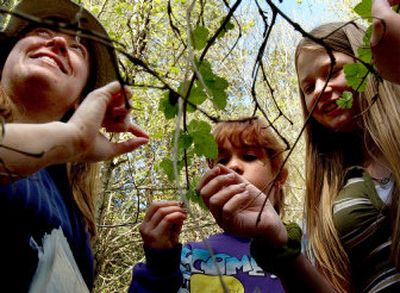
Sixth-grade students from Harrison Elementary School in south Kootenai County played in the mud, looked at bugs and romped around making animal noises during class Tuesday.
Not a typical school day, but the students weren’t supposed to learn typical school stuff.
They were taking part in the Coeur d’Alene Tribe’s Water Awareness Week, held on the reservation near Lake Creek.
Every year, the tribe puts on a series of workshops during statewide Water Awareness Week aimed at teaching elementary and middle school students about tribal culture and the relationship between water quality, wildlife and everything else in nature.
“Some of this stuff we don’t learn in school,” said Kendall Walton. “I’m going to tell my parents everything I learned that they probably don’t know. That will be fun.”
Schools from all over North Idaho bring students to the workshops, with most days bringing about 50 or 60 students, said Mark Stanger, an education and outreach specialist with the tribe’s fish and wildlife department. Tuesday wasn’t as busy; Glenda Cooper’s sixth-grade class of about 25 was the only one there.
The experience is immeasurable for students, Cooper said. “The kids just love it.”
Bruce Kinkead, a fish biologist with the tribe, hosted a workshop to explore the different insects living in water bodies. Ice cube trays filled with the crawlers sat next to a large pan of muddy, grassy water filled with even more of them.
“You want to hold him?” Kinkead asked the group of girls in front of him as he picked up one of the creatures.
“No!” they shrieked simultaneously, some giggling, others shuddering.
But most gave in eventually and held some of the creatures, some using their fingers, others using tweezers.
“Don’t always assume the girls are wussy,” Kinkead said. “The girls will either be the brave ones or the screamers; the guys are in between.”
But the boys seemed undaunted when asked to get their hands a little dirty, or “soily,” as Laura Laumatia would prefer it called.
“I keep hearing the D-word, and I don’t like that,” the extension educator with the tribe told the boys.
Laumatia was teaching the students about soil – the different types and how to determine them.
Though one boy suggested only those with a college education could determine the age and type of soil, Laumatia showed the students that anyone can do it with a little bit of training.
“This is all it takes to do a soil test,” she said, pressing a clump of soil in her hand with her thumb.
Kendall and her classmate Dusty Nope enjoyed all the workshops, but the one about tribal language had them hooked, they said. For that one, students walked down a trail with the workshop leader, making the appropriate animal noises after being shown a picture of the animal and hearing the tribal word for it.
“It’s like charades,” Kendall said. “That’s why it’s fun.”
All students heard from tribal elder Felix Aripa, who talked about the history of the land and about past and present methods for preserving it.
He discussed efforts to restore cutthroat salmon – efforts he said are clearly working – and described how animals can give clues about the changing seasons though their behavior.
Sixth-grader Miranda Griggs said the best part about the day was simple.
“You get to be in nature, and I love nature,” she said.