
Careful observers help find missing kids

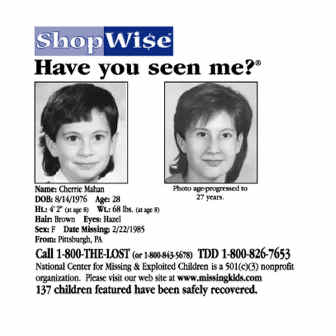
NEW YORK – Janice McKinney and Enrico Wallenda both make a personal plea: Look at those postcards featuring the faces of missing children that arrive in your mailbox. You might be able to help save a life.
McKinney’s daughter was kidnapped near her suburban Pittsburgh home and never found; Wallenda’s daughter was abducted and wound up in a homeless shelter in San Diego before being returned to Florida and her family.
Both were featured on the postcards with the words “Have you seen me?” written underneath that are distributed by Advo, a marketing company that does mass-mailings for retailers. So have 1,000 other missing kids. One in six has been found safely – with links to the cards.
There also is the broader effect that when Advo sends 85 million postcards around the nation each week, the company approaches local media and shines further attention, sometimes renewing the public’s interest and awareness in a case that, as time goes by, might lose its sense of urgency.
The first card, which featured McKinney’s daughter Cherrie Mahan, was sent out 20 years ago. McKinney says the Advo card provided some comfort when she felt like she had run out of options with local law enforcement.
“It was a very emotional thing. I really thought that if she was anywhere and someone saw that card, someone would bring her home to me. I still think that,” she says. Updated cards for Cherrie continue to be sent out, including one this month; her photo has been “aged” to reflect what a 29-year-old woman would now look like.
McKinney says she’d understand if Advo, which works directly with the nonprofit National Center for Missing & Exploited Children, turned its attention to other cases but she’s thankful that the effort continues. She hopes someday she’ll finally find out what happened that February day in 1985 and she’ll have some closure.
“Advo has been so supportive of me…. They have put her picture out again and again. I’ll ask, `Don’t you think there is someone else out there more deserving than Cherrie?’ Then Vince says, ‘No, there isn’t.”’
Vince is Vince Guiliano, senior vice president of government relations at Advo. It was his idea to feature missing children on the postcards that the company was already sending out.
The impetus was the 1983 TV movie “Adam,” based on the real-life kidnapping of Adam Walsh in a department store, explains Guiliano, himself a father of three. He also was trying to fulfill President Reagan’s call to action for private companies to take on good-will initiatives.
Guiliano met with Adam’s father, John Walsh, who later went on to co-found the National Center and to host “America’s Most Wanted” on television. Walsh was one of the early supporters of the Advo cards.
“It turned out that the movie was an understatement. John explained that people didn’t have resources to find children. … People in one town, one jurisdiction couldn’t help another. He said if his son had been a stolen car, it would have been no problem, but there just wasn’t anything for children,” Guiliano says.
So he took his idea to the National Center, which was at first hesitant to partner with an advertising company, concerned that a business would somehow exploit the plight of the families. But Guiliano pushed ahead, avoiding potential complaints that the company might somehow exploit the affected families in a commercial endeavor. He says he knew in the long run that the postcards would prove a helpful tool, especially by putting faces on the front, and the cards would only feature products children would never make decisions about, such as auto services and carpet cleaners.
Guiliano went to the Office of Juvenile Justice, part of the federal Justice Department, which gave him its blessing. The next obstacle was a U.S. Postal Service rule that prohibited anything other than an address to appear on the front of a card, but that was ultimately reversed.
Cherrie, who was in the third grade at the time of her abduction, was chosen for the first card because there were concrete leads — including a description of the blue or green van that she was believed to be forced into. “If there had been an Amber Alert in those days, I think Cherrie would’ve been recovered,” Guiliano says.
McKinney studies each card that comes to her house. “I take it out and look at it. I say, `This could be our kid. Let’s see what we can do.”
She adds: “To some people, they say, `Things like this don’t happen to me, they can’t happen to me.’ But it can and it does happen to ordinary people. When people realize that, they look at the card a little more closely. All the people I know do.”
Wallenda, whose daughter, Olivia Salisbury, was taken by her noncustodial parent, makes it a habit of keeping each card on his desk for a few days, long enough to commit each face to memory.
He operates a small trailer park in Florida and he sees a lot of transient people pass through. “I’m always expecting one day that one of these kids will show up here. … Maybe I’ll see them in Wal-Mart.”
It was someone’s sharp eye who noticed Olivia, who is now 9 and spending most of her spare time learning acrobatics to carry on the family circus act, The Great Wallendas.
It took seven months to find Olivia and Wallenda was starting to give up hope. “Because of the card, we found her. Advo took this seriously and the people on the other end (in San Diego) took this seriously. We were so pleased to get her back — and it was a shock to get her back safely,” he says.