
Director shooting for right goals

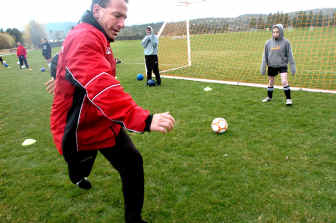
FOR ERIC SWANBECK, it is not whether you win or lose, it is how you play the game. Swanbeck, 47, is the new director for the Sandpoint Soccer Association and oversees the Strikers and the Youth League.
A veteran collegiate coach, Olympic development coach and former semipro soccer player, Swanbeck is excited about working with the young soccer players.
“My goal is the overall development of the kids, with character development as the focus,” said Swanbeck.
After coaching at the college level for more than 20 years, Swanbeck decided to leave the university system and focus on working with younger players.
“The academic and behavioral standards I set for my players were not being supported by my employers,” said Swanbeck. “Really at the collegiate level, it (sports) is more of a business.”
So after his contract was up at Minnesota State University in 2004, Swanbeck decided to head west. An avid outdoorsman and wildlife photographer, Swanbeck knew he wanted to live among the mountains. Missoula was his first stop.
“I was looking for a program that supported the standards I had for my kids,” he said. “Then I heard about this position (director), and it seemed like a perfect fit.”
According to Swanbeck, what attracted him most to the Sandpoint job was the system that had been put in place by his predecessor, Ray Smith. During his tenure as director, Smith vowed to make sportsmanship his top priority. In doing so, he instituted a code of conduct which spells out expectations and consequences of behavior for not only the players, but the parents as well.
“It is great to have a code of conduct,” says Swanbeck, “but there also needs to be accountability.” And according to Swanbeck, the Sandpoint program had just that.
Smith said that since he introduced the code of conduct three years ago, there has been a significant improvement in the behavior and attitudes of all involved.
“If you have discipline and character, winning follows,” said Smith. “Eric has the same philosophy, and he’ll be a good fit to the program.”
Swanbeck arrived in Sandpoint at the beginning of March, right at the beginning of the busy spring soccer season. His job includes overseeing the Striker program, which is composed of 300 boys and girls as well as 80 teams in the youth league. The youth teams include more than 750 kids.
First on Swanbeck’s agenda was to hold meetings with all of the Striker teams. Knowing there would be some testing of the new guy on the block, Swanbeck made it clear to the players that he had the same expectations as his predecessor.
“He told us he has high expectations for the club,” said 11-year-old Jansen Rinck, who is in his third year with the Strikers. “He makes you work hard during practice and shows us some really good things, but he’s really personable too.”
Rinck said that any player late to practice is required to do an extra workout. Realizing that tardiness takes away from the team, the young soccer player knows that the conduct requirements are enforced to teach respect and character.
“I’ve learned to treat my peers fairly,” said Rinck, “and I’ve built a strong relationship with my teammates.”
Although academic standards are not enforced at the youth level, it is something which Swanbeck has emphasized throughout his collegiate coaching career. As athletic director and head soccer coach at Notre Dame Women’s College, Swanbeck introduced an academic enhancement program.
“After their freshman year, they (the players) had to maintain at least a 2.5 grade-point average. If they didn’t, then they were required to attend six hours per week in study hall,” said Swanbeck.
The results were amazing. He watched one young woman raise her GPA from 1.5 to 3.6 in just one semester. Not only was she able to participate in the sport she loved, but she achieved academically as well, receiving an award for academic excellence. The program resulted in 70 percent of the student athletes in all sports at Notre Dame Women’s College maintaining at least a 3.0 grade-point average.
Swanbeck said that academic excellence is slowly becoming an expectation not only among coaches, but also among the young people; and making character building the cornerstone of his coaching has resulted in kids becoming more aware of the importance of both good sportsmanship and academic achievement.
“Kids today are knowledgeable and know they need good grades,” said Swanbeck. “But character is at the forefront; there won’t be any give on that.”