
Great Aunt’s clock gains in value over time
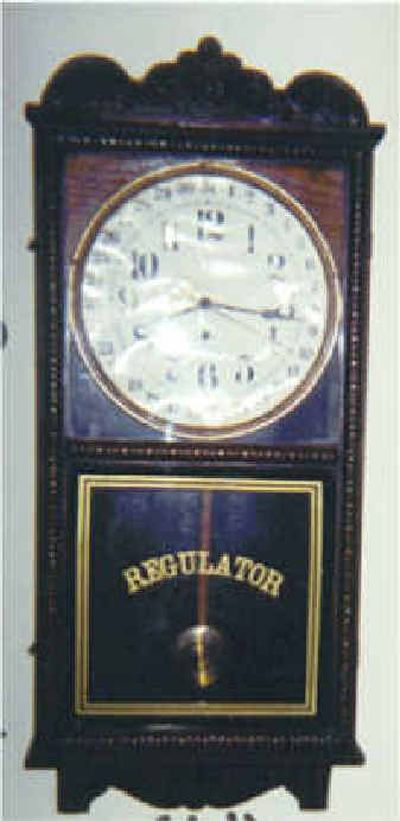

Dear Collector: This clock hung in my great aunt’s store in the early 1950s. I would appreciate learning anything you can tell me about it.
This circa 1918 regulator (a term used for accurate commercial timepieces) was made by Waterbury. The current value of your wall clock in the Crane pattern is $500-$600.
Dear Collector: I have a decent copy of “Metronome” dated April, 1941; is it worth anything?
A music magazine dedicated to “bands-records- radio,” the first issue of Metronome came out in the 1880s. A value of $7-$9 is about right for your edition.
Dear Collector: Enclosed is a photo of a four-shot .22-caliber Sharps pistol. What is its value?
Nicknamed a “pepperbox” due to its supposed resemblance to an old-time pepper mill, this pocket pistol was the first model made between 1859 and 1874 by Sharps, famous for their accurate and powerful rifles. Insurance value is at least $500.
Dear Collector: I bought this unusual Teddy bear at a garage sale and I’m curious as to its age.
A teddy dressed in Royal Stewart britches is unusual indeed! I found your 1960 Wendy Boston bear on page 324 of “The Teddy Bear Encyclopedia” (DK, 2001, $16.95) by Pauline Cockrill. Unfortunately, the author does not include a price list in her interesting guide.
Dear Collector: Would appreciate age and value of this cigarette lighter left to my son by his late great-grandfather.
Because its use became common in the Great War, this style is called a “trench” lighter. A product of Bowers Manufacturing, located in Kalamazoo, Mich., your Surefire is cased in chromium, which has darkened over the years. Its worth, in working order, is between $30 and $50.
Dear Collector: After an uncle died, I found these United Profit-Sharing coupons in his belongings. Could you tell us about them?
Back before there were Green Stamps, United included its redemption vouchers in many products during the 1920s and ‘30s. Cigars, peanuts, soap, Wrigley’s gum and Tootsie Rolls offered these coupons, which could then be exchanged for merchandise in a “Good as Gold” catalog.
Your keepsakes, while having little monetary value, are valuable reminders of days bygone.
Dear Collector: I’m referring to your humorous response about a reader’s question of a “serving bowl” that was actually a chamber pot. Did you write this with a grin or straight faced?
All alleged humor (implied or otherwise) appearing in answers, is the sole responsibility of this columnist.
Dear Collector: I have a 1908 silver dollar that belonged to my mother; it was the year she was born.
Check the denomination on your coin; the United States didn’t mint any silver dollars that year.
Dear Collector: Who made this Willow cup and saucer?
They can be traced to W.A. Adderley of Longton, England, and are listed in one price guide at $50 the pair.
Dear Collector: How much is my RCA radio worth?
At the very least I’ll need a model number and its condition. A nice photo would also help.
Recommended reading: “Corgi Juniors & Husky Models,” Bill Manzke (Schiffer, 2004, $34.95)
“20th Century Antiques,” Martin Miller (Carlton Books, 2003, $19.95)
“Taylor, Smith & Taylor Dinnerware,” Mark Gonzalez (Schiffer, 2004, $29.95).