
Show and tell
Did a camel spider ever chase you?
Pfc. Issac Barnhart has been asked a lot of questions about Iraq, but this one flung out by a fourth-grader stopped him in his tracks for a split-second.
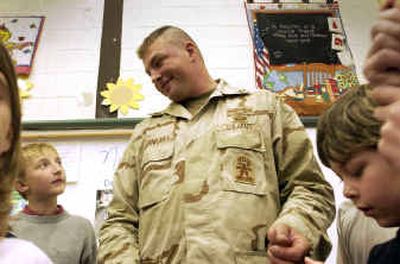
Barnhart, home on a 10-day leave, spent some time Friday afternoon visiting pen pals at Seltice Elementary School in Post Falls. The tall, broad soldier, decked out in his tan desert camos, paced back and forth in front of a crowd of fourth- and fifth-graders seated on the floor and firing their hands into the air with questions. Barnhart looked athletic and bounced around on the balls of his feet as he called upon students around the room.
So, has a camel spider – a carnivorous arachnid that can grow as big as a dinner plate – ever chased you?
Barnhart stopped and cocked his head. “No,” he said after a brief, amused pause. “The one I saw was running away.”
The children didn’t run away from tough questions about being a soldier in Iraq.
Do you ever get scared?
Do you know anyone who’s died?
Have you ever killed anyone?
These and many others were posed with directness and innocence.
Yes, the big soldier said, “We got mortared one time, and that was really scary. A mortar is like a grenade, it’s about this big and it flies up in the air and comes down in another spot. We had three of them land in our building. It was very scary.”
And yes, Barnhart said, one friend in his unit has been killed in Iraq and another suffered wounds severe enough to be sent home to the United States.
He was more circumspect on the question of killing.
“Some people die in wars. I’ll just say that.”
He also told the kids he plays football with his friends in Iraq, that Iraqi kids watch TV and like chocolate and they eat a lot of rice and flat bread – kind of like pita bread – that you can buy for 75 cents and fill with meat or cucumbers or tomatoes.
He pulled out a wad of money – “These are dinars” – and passed them around the room. He passed around a bullet from a machine gun.
“I wanted to know what it was like in Iraq,” said Alex Marmon, 10, one of the questioners. “On TV it looks a lot scarier than he said it was.”
Barnhart said he is happy to talk about Iraq and counter the perception that it is only about ambush and death. He serves in the 509th Airborne and said his half-year patrolling Baghdad, Fallujah and the town of Abu Ghraib have shown him most Iraqis are happy the American-led coalition forces are in the country, he said. Electricity, though it can still be sporadic, is largely reliable again in the cities. Kids are going to school.
He said he has even entered a mud-walled house in the countryside and found the residents had set up a 42-inch plasma TV with a satellite dish on the roof – the sort of window to the world not allowed under Saddam Hussein’s rule.
He said it’s wrong to ask if civilian life is getting back to normal in Iraq. First, he said, life in a dictatorship with secret police is hardly normal. And then a decade under no-fly zones and economic sanctions further removed any sense of normalcy.
What he does see, Barnhart said, is a hunger for liberty and safety and desire to live out from under a totalitarian government.
“If we’ve caught Saddam,” one kid asked thoughtfully, “why are we still there?”
“There are still some of his old soldiers and they are fighting us,” Barnhart said. “They don’t want Iraq to be free.”
The questions in the class were much like the packets of letters he receives from his pen pals in Laurie Buckel’s fourth-grade class at Seltice, Barnhart said. Barnhart is married to Buckel’s daughter, Erin, and the close connection sparked the idea for the letter exchange.
He said the letters are a pleasure.
Even though he firmly believes the overthrow of Saddam and the ongoing occupation are bringing good to Iraq, being an American soldier there can still be – to use a child’s term – scary. Or disturbing.
He shares the letters with the soldiers in his unit. The children “always ask if I drive a tank – I got that one about four times today even – or what do we eat. Or have I killed anybody.
“They are kids. They are so innocent,” Barnhart said. “It’s nice to have some innocence over there.”