
From ‘The Natural’ to natural resources, the late Robert Redford adored the Palouse
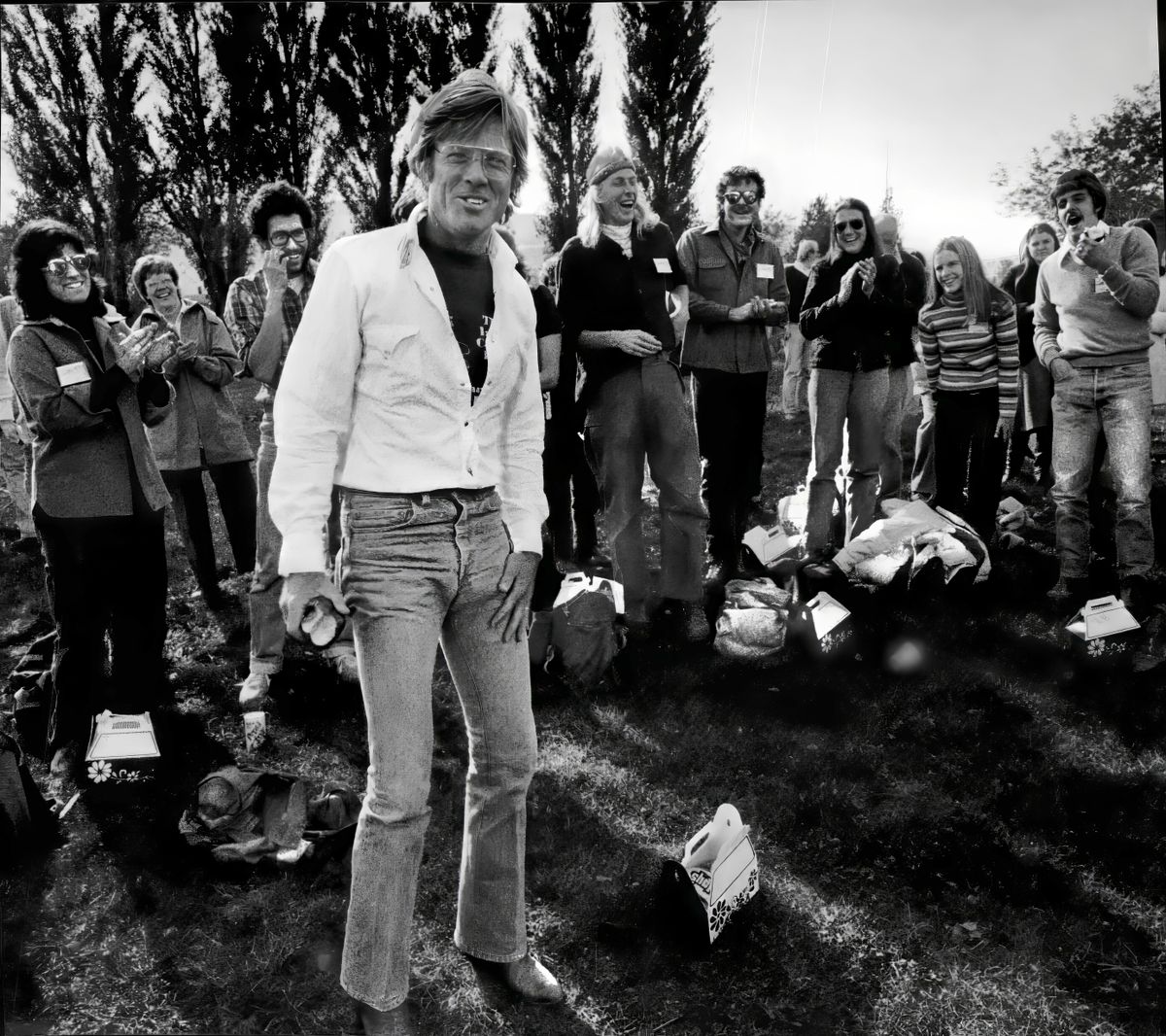
When “natural” and late actor, director and activist Robert Redford are uttered in the same sentence, it’s usually a glowing recollection of his performance in the 1984 sports drama classic “The Natural.”
But longtime local residents may instead recall the leading man’s efforts to preserve America’s natural resources, including an ambitious plan rooted in the Palouse.
In the late 1970s, Redford came up with an idea to address what he saw as a lack of qualified professionals able to contend with the challenges facing the West and its communities.
He then set out on finding the ideal location for an institute to produce those professionals. After denying more than 50 universities who applied to host it, he landed on Washington State University and the University of Idaho.
Redford, whose film credits include “Butch Cassidy and the Sundance Kid,” “The Sting,” “The Horse Whisperer,” “Ordinary People,” “All the President’s Men” and many more, died Tuesday. He was 89.
Among his off-screen accomplishments was trying to address the challenges of the late 1970s and early 1980s that are not unlike those still facing the region, where industries like timber, mining and agriculture must coexist with the conservationists, outdoorsmen and tribes that also call the West home. All the while, a growing population has led to more development of the land at the center of the conflicts.
Redford told a group of local reporters on a visit to Palouse Falls in 1982 that the conflicts often are not resolved until they reach a judge. Industrial development, he said, is often stopped in the courts because those managing the projects give little consideration to local residents’ concerns about environmental changes, and subsequently have lawsuits filed against them.
The lawsuits stall construction, resulting in higher building costs. Developers get angry at the local residents, and the locals are steamed at the developers.
“An inflammatory debate results,” the actor said, “and nothing gets done. … No progress occurs, and preservation, which should be good for the human spirit, takes on a bad tone.”
If “there was some kind of forward thought” before the bulldozers started to roll, many problems could be avoided, he said.
WSU and UI’s Institute for Resource Management was thus founded with the hope its graduates would lead the charge in changing those dynamics from adversarial to congenial, if not cooperative.
Redford determined the Palouse to be an ideal location due to the natural resource and agricultural programs at both schools, their established collaborative relationship and their close proximity to a wide variety of natural resources and industries those resources support, as reported by the Spokane Chronicle at the time.
Ed Krumpe, a retired UI natural resources professor, said it was an exciting time for the region. His recollection was that Redford and his people reached out first to his former institution, which later looped in their neighbors across the border.
“He was very intent and interested in what was going on, and we were pleased he would look this far north,” Krumpe said. “He seemed to know a lot about the programs, and so we thought that spoke well of his investigation, staff, of where to get established.”
When Redford came up with the idea for the institute in 1977, he thought it should be federally funded. But after an $80,000 study by the Department of the Interior, he decided to raise private money instead. He dedicated $400,000 to be split between the campuses to get the program off the ground while he sought funding to establish a $5 million endowment.
The full endowment for the institute never quite came to fruition, which led in large part to the program’s shuttering within a few years of its inception, according to the university publication the Idaho Harvester.
“They got a number of these students enrolled and actually finished,” Krumpe said. “But I think the funding sources were not what they had expected.”
Regardless, Redford still made more than a few memorable trips to the Inland Northwest to visit his brainchild, its graduate students and the region’s prominent archaeological and natural sites.
The trips that made headlines came mostly in 1982, just a few months after the first cohort of 20 graduate fellows began at the institute.
Over a few days in October of that year, Redford, the fellows, university researchers and world-renowned anthropologist Richard Leakey, who died in 2022, visited the Palouse Falls, Lyons Ferry State Park and the Marmac Rockshelter. The latter was the site of several prominent archaeological discoveries, including the roughly 12,000-year-old Indigenous remains dubbed the Marmes Man, then the oldest human skeletal remains ever unearthed. The site was flooded in 1968 during the construction of the Lower Monumental Dam.
Krumpe sat next to Redford on one of those bus rides. He remembers him as a kind, involved man with a firm handshake and plenty of good questions.
“I was sad to hear that he passed,” Krumpe said Tuesday. “He’s done a lot over the years, both for the entertainment industry, but also an awful lot for conservation, too.”
The day after that ride with Krumpe, Redford was on another discovery trip with the group when the actor had to give his best impression of a first responder.
The bus carrying Redford and around 50 others was winding its way through the Channeled Scablands when it caught fire coming up a hill. The bus driver ordered everyone off the bus, fearful it may explode.
Meanwhile, Redford, sporting faded jeans, cowboy boots and white Western shirt over a T-shirt that read “The Best Hump In Town,” got to work hauling water to pour on the engine and assisting with the clean-up.
“This is what takes money from education,” Redford joked as he helped remove coats and backpacks from the smoke-filled bus. “You’ve got to be flexible in this changing world.”