
Kids and squids: Third-graders conquer fears, learn science in squid dissection field trip
Fish. The ocean. Stinky.
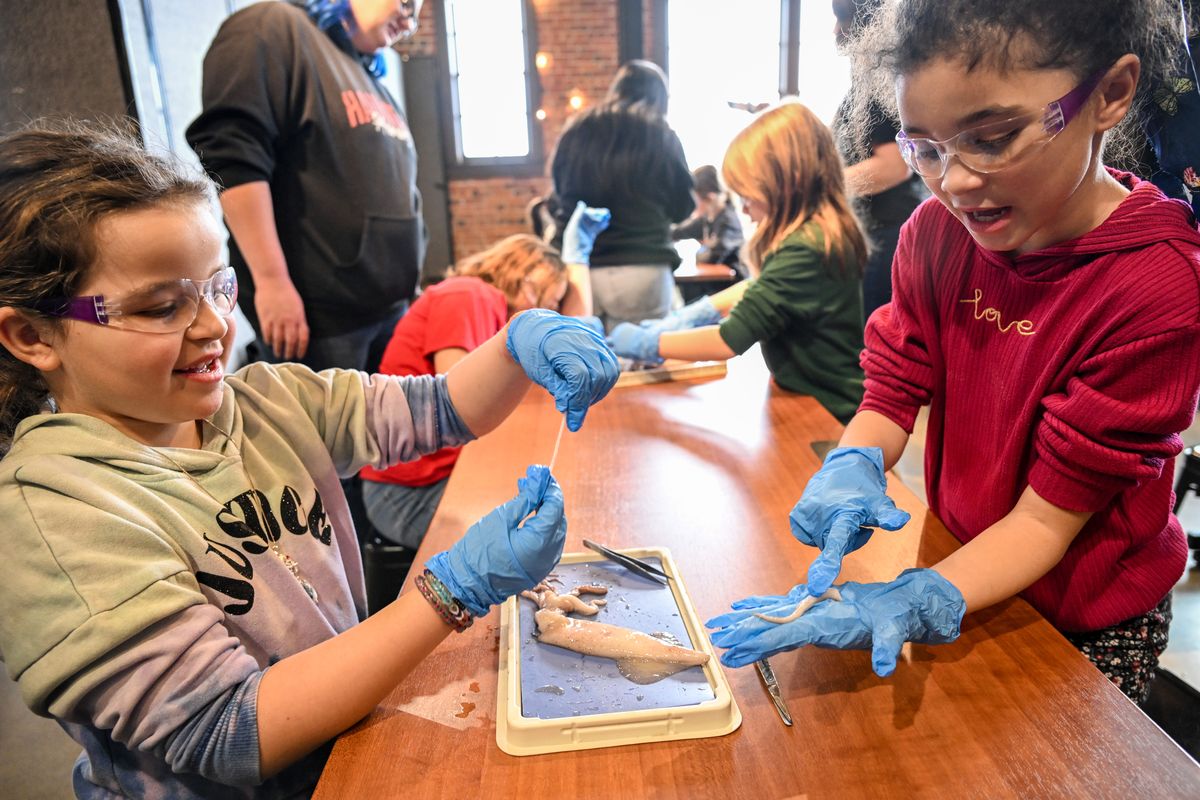
The room full of third-graders was quick to answer when Tiniya Dixon, a public programs coordinator at Mobius Discovery Center, queried them on what the aroma making its way around the building smelled like. A couple sat with their shirts over their noses to block the stench, initially disgusted, then curious as Dixon began to distribute to each student trays holding the source of the smell: about a dozen small squids.
On Tuesday, Westview third-graders from teacher Tiffiny Santos’ class spent the day at Mobius for a science-filled field trip culminating in the stinky, fear-inducing, curiosity-sparking squid dissection.
Reading from a book is one thing, Santos said, but “it’s a whole different thing to touch it; they will never forget this experience.”
For about an hour, Dixon guided the pupils around the anatomy of the aquatic creatures, instructing kids to snip off a tentacle, slice open the mandible and gently poke the massive, cloudy eye of the beast.
It’s the last lesson in the third-graders’ unit on the ocean, during which they learn about SCUBA-inventor Jaques Cousteau and do a live video chat with an oceanologist who tags sharks for a living.
Santos hopes the experience will spark her kids’ interest in careers in STEM, which stands for science, technology, engineering and math. It’s Mobius’ area of expertise.
“Beyond that it was a squid, it gives them an experience like a scientist, that they can take away from them and say, ‘That was cool; maybe I will try that class in middle school or high school or college, or maybe I really am interested in biology,’ ” Santos said.
Aside from the direct lessons in animal dissection and squid anatomy, the experience instills kids with a lesson to apply in any area of life: conquering their fears.
Safe to say, handling a squid’s carcass was outside of 8-year-old Jazmine McKinnon’s comfort zone by miles.
“I was like, ‘What?’ ” Jazmine said of her reaction to the dissection, scrunching up her face in confusion. “It’s not normal; I’ve never done a thing like that in my life.”
Initially, Jazmine and many of her peers were disgusted by the prospect, even scared to come in such close proximity to the tentacled beast.
“I literally almost puked,” she said when her lab partner, Gianna Adams, snipped off a tentacle. Nonetheless, she reached for their shared pair of scissors to cut off one of the creature’s arms. Though she was repulsed each time she came in contact with the squid, it didn’t stop her from going in for another squish.
“I know that it’s fine because it’s dead and you don’t have to worry about it,” she reassured herself.
Student Rylie Lynn was also disgusted when Santos said her class would be dissecting squid. It proved more enjoyable than it sounded, the 8-year-old said, when she and her partner peeled back the squid’s mandible and discovered a long, straw-shaped piece of cartilage aptly called the squid’s “pen.” It connects to the ink sack, which kids also pulled from the animal and dipped the pen in to draw pictures.
One pair of pupils drew the figures “6” and “7” in squid ink in honor of a viral, nonsensical meme circulating through classrooms and beyond.
“When I cut it open, I realized it wasn’t that scary,” Rylie said.
Rylie said the experience opened her eyes to a possible future career studying ocean animals. Turtles are her favorite, she said.
“I might want to explore more animals that nobody saw,” Rylie said.
Jazmine found she may be less animal-inclined than Rylie, still harboring a fear of frogs. The field trip was still meaningful, she said. It’s helped push her to explore outside her comfort zone more often, like maybe “swimming in deeper parts of water and stuff,” she said.
“It lets them take that step into something they don’t think they want to do, or they don’t think they can do, and to see that ‘I can do this, I can engage in science and be successful,’” Santos said. “All of that, there’s just so much that happens here in a day.”